A General Council acts every day for residents and businesses in the county.
Do you know exactly what it does for you?
Do you know exactly what it does for you?
A department is a local authority, as a region or common. Our department is administered by the General Council of Morbihan: *
a county council, composed of 42 councilors elected for 6 years, which set the framework of departmental policies and vote the budget and they meet four times a year at least , with plenary sessions;
In March 2011, half of councilors will be renewed (say cantonal elections), including those of West Vannes and Vannes Centre
* departmental services, about 2,700 people, divided throughout the department to prepare and execute decisions taken by the departmental assembly.
A General Council is therefore both a decision-making and political action, and a set of utilities county.
Every day, your General Council supports you, directly or indirectly, in almost all aspects of life: childhood, education, education, leisure, recreation, employment, occupation, health, individual and collective transport, environment ...
His skills required :
Welfare
* * * County roads Road transport Traveler
* shipping to the islands
* shipping to the islands
* Construction, maintenance and operation of public colleges
* Art Education * Rural Development
* Media * Departmental Departmental Archives
His skills Optional:
Policies specific are determined by the county council to improve the environment and quality of life of Morbihan in the following areas:
* Planning * Economic Development * Tourism *
His skills Optional:
Policies specific are determined by the county council to improve the environment and quality of life of Morbihan in the following areas:
* Planning * Economic Development * Tourism *
Quality of life and leisure
Some data on the budget of the department of Morbihan:
* Revenue: € 692 million

Expenditures *: 692 million euros, with € 116 million (16.7%) for members, € 58M (8.3%) for debt and financial flows. So 518 million € s personal debt / financial movements
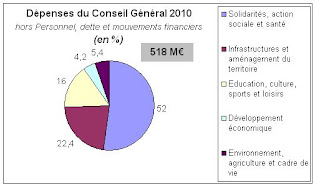
Social action: almost 40% of the total budget, 52% of expenditure Operating (excluding personal debt / financial movements)


We note that "Solidarity and Social Action" represent more than half of operating budget (excluding staff), although other Breton departments are even better in this area. Note that approximately one third of the 2,700 county agents working in the field of social action.
Then come the roads and colleges. The budget for roads is particularly important. Andrew Gall wants a thorough examination of this policy. This may he continue? Is there not a contradiction with the stated aim of sustainable development? By
cons considerable delay was taken regarding the creation of real bike lanes, secure, which would also be very favorable to tourism.
All the foregoing shows that the policies chosen and implemented by the General Council occur at different times of life (early childhood, middle school, old age ...) as well as on many aspects of daily life (RSA, housing, transportation, public reading, environment, etc. ...).
The cantonal elections are therefore of prime importance for every individual in the department.
 Hervé Pellois and Andrew Gall, Socialist councilors, a critical issue due to the overall functioning of the General Council of Morbihan. Records and documents prepared by the services before the committee or plenary sessions, often bulky, too arrive shortly before examination. They are not or very little discussed in advance with the elected. They are not really amendable during votes. Decisions are actually made by a small circle too: President, Vice Presidents and senior administrators. The problem of the role of elected officials to techno, and the mode of relations, is set.
 They believe that the Morbihan works to "lower limit" of democracy. Could this be a distant legacy of the "period Marcellin?
A left-wing majority will remedy this situation, given its place in the debate, transparency choices and decisions.
And so much more than the land reform which has been passed, reducing the departments' own resources, increasing the relative share of state allocations, reduce their financial independence and further lower investment, already sensitive 2009 and 2010.
In terms of expenditure priorities need to be developed draconian: it is feared that aid to municipalities and cultural associations and sports do well costs.
And so much more than the land reform which has been passed, reducing the departments' own resources, increasing the relative share of state allocations, reduce their financial independence and further lower investment, already sensitive 2009 and 2010.
In terms of expenditure priorities need to be developed draconian: it is feared that aid to municipalities and cultural associations and sports do well costs.


0 comments:
Post a Comment